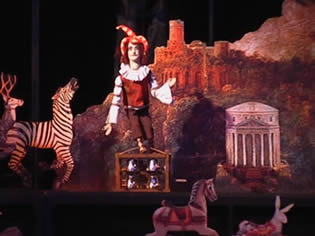
PERFORMANCE DETAILS The Magic Flute does not often appear in the repertoire of the National Marionette Theatre in Prague, but when it does it is a joy to experience. In this marionette version of Mozart's famous opera, the story is told by tall, almost life-size puppets dressed in 18th century period costumes. In marionette theatre the story is recounted visually, with little or no spoken dialogue. This makes the shows ideal for an international audience, for both adults and children. This version of The Magic Flute runs for one hour and is therefore an abridged version of the full stage opera. However, visitors may find it useful to read the synopsis for the original, to understand the story the puppets are acting out. Synopsis for the full opera version of The Magic Flute
---------------------------------------------------------
The Magic Flute (German: Die Zauberflöte) is the last opera of Wolfgang Amadeus Mozart, from 1791. Is this masterpiece a fairy‑tale with comic elements, a folk comedy, or an encoded work filled with Freemasonry symbols? Or is it simply a story of love overcoming all obstacles, or a motivational piece encouraging the audience to strive for perfection?
In truth, The Magic Flute contains all these elements. It is a magical fairy‑tale and a multi‑layered play full of fantasy, humour and philosophy. The characters of Prince Tamino, Princess Pamina, the wise Sarastro, the evil Queen of the Night, and the jolly bird‑catcher Papageno have entertained audiences worldwide for over 200 years.
Act I begins with Prince Tamino being chased by a serpent in a far‑off land. Exhausted, he collapses, and three of the Queen’s ladies appear and kill the serpent. Fascinated by the handsome prince, they argue over who should stay with him while the Queen is informed, but eventually decide to leave together.
A bird‑catcher, Papageno, arrives and laments his desire for a wife. When Tamino regains consciousness, Papageno claims he saved Tamino’s life. At that moment, the three ladies return and punish Papageno for lying by conjuring a padlock onto his mouth. They present Tamino with a portrait of the Queen’s daughter, Pamina, who has been captured by the villain Sarastro. The Queen’s arrival is marked by a thunderclap, and she commands Tamino to rescue her daughter, promising Pamina’s hand in marriage if he succeeds. Before he departs, Tamino is given a magic flute, Papageno is given silver bells for protection, and three spirit guides are appointed to assist them.
Papageno frightens away Monostatos, Sarastro’s slave, who is pursuing Pamina. He reassures her that Tamino, a prince who loves her, will soon rescue her. Meanwhile, the spirit guides lead Tamino to Sarastro’s temple, where an old priest reveals that the Queen is the one who is evil. Tamino uses the magic flute to search for Papageno and Pamina, enchanting animals who show him the way. Papageno and Pamina are on their way to find Tamino when they are seized by Monostatos and his slaves. Papageno rings his silver bells, enchanting the attackers and sending them dancing away. Their escape is interrupted by Sarastro’s entrance. Pamina insists they must tell him the truth.
When Sarastro appears in regal splendour, Pamina throws herself at his feet and confesses that she tried to flee. Sarastro forgives her but declares that she cannot leave without the guidance of a man. Monostatos brings in Tamino, whom he has captured, and when Tamino and Pamina see one another for the first time, they fall instantly in love. Sarastro punishes Monostatos for frightening Pamina and attempting to force her affections, then leads Tamino and Pamina into the temple.
Act II
Sarastro summons a council of priests to discuss Tamino and Pamina’s marriage. They agree that Tamino is worthy of Pamina and of succeeding Sarastro as leader of the brotherhood—if he can pass the trials. Sarastro explains that the Queen of the Night has been misleading people into believing he is evil, and he fears she may try to harm Tamino or Pamina. He prays for the gods to protect them and unite them in the afterlife should danger strike.
As Tamino and Papageno are led to the trials, a priest asks whether they are certain they wish to proceed. Tamino, determined to win Pamina, agrees firmly, while Papageno initially refuses, then quickly changes his mind when told he may win a wife. In the first trial, they must remain silent while being tempted by the three ladies. Papageno cannot resist replying to them, while Tamino maintains his silence. Realising Tamino will not speak to them, the ladies retreat. Tamino is praised by the priests, while Papageno is reprimanded.
Meanwhile, the Queen of the Night visits Pamina and gives her a dagger, commanding her to kill Tamino. Monostatos, having heard the plot, approaches Pamina and threatens to force himself upon her unless she yields. Sarastro appears just in time, drives Monostatos away and comforts Pamina.
Tamino continues to succeed in each challenge, impressing the priests. Papageno, however, fares poorly. The next task requires them to remain silent and refuse food. Pamina arrives to speak to Tamino, but bound by the trial, he cannot answer her. Believing he no longer loves her, she is plunged into despair.
Papageno fails again when he accepts a drink of water from an elderly woman. Longing for a wife, he agrees to promise himself to her. As soon as he does, she transforms into the young Papagena before vanishing again, leaving Papageno dumbfounded.
For the final trial, Tamino and Pamina are reunited. Now permitted to speak, Tamino asks for her forgiveness. Strengthened by their love and protected by the magic flute, they pass through the trial of water and fire together.
Elsewhere, Papageno, heartbroken at losing Papagena, contemplates ending his life, but the three spirits stop him and urge him to ring his magic bells to summon her. He does so, and Papagena returns, bringing him great joy.
Monostatos, the Queen of the Night and the three spirits attempt to storm the temple, but they are overpowered by magic and banished. Sarastro then brings Tamino, Pamina, Papageno and Papagena before the brotherhood and blesses them, praising their strength, trust and courage. |