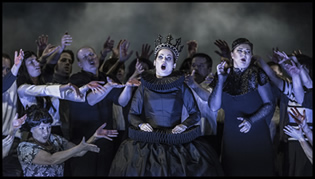
Giuseppe Verdi was an ardent admirer of William Shakespeare, so it is little surprise that he chose the playwright’s works as the basis for three of his operas.
In Macbeth he recognised the dramatic potential in the tale of the corrupting force of power, and Piave’s libretto follows the play’s storyline with striking fidelity. Following its premiere on 14th March 1847 at the Teatro alla Pergola in Florence, Macbeth began its triumphant journey across Europe. It was staged in its original form until 1865, when Verdi substantially revised it for a performance in Paris.
Act I begins in Scotland in the 11th century. The Scottish army leader Macbeth, accompanied by his friend Banquo, enters the woods where they encounter a group of witches who prophesy the future. They hail Macbeth as Thane of Cawdor and as the future King of Scotland — neither of which he currently is. They also tell Banquo he will father kings. Intrigued by their cryptic words, Macbeth tries to learn more, but the witches vanish. Messengers arrive and inform Macbeth that Duncan, the King of Scotland, has named him Thane of Cawdor. Macbeth and Banquo are stunned, realising that the witches’ first prediction has already come true.
At Macbeth’s castle, Lady Macbeth reads a letter from her husband recounting the encounter and his new title. Her ambition is awakened, and she resolves to do all she can to help Macbeth become king. Learning that Duncan will spend the night at their castle, she plots his murder.
When the king and his court arrive, Lady Macbeth urges her husband to kill Duncan, despite Macbeth being shaken by terrifying visions of a dagger. Spurred on by her relentless persuasion, he ignores the warnings and murders the king.
The next morning, Banquo and Macduff discover Duncan’s body and begin searching for the traitor. To hide their guilt, Macbeth and Lady Macbeth join in lamenting the king’s death and pretend to help hunt for the murderer.
Act II
Duncan’s son Malcolm is accused of killing his father and flees the country, allowing Macbeth to claim the throne. With the witches’ first prophecy fulfilled, Macbeth fears that the second — that Banquo will father kings — will also come true. To secure his place, he plots to kill Banquo and his son, Fleance, during a banquet. Macbeth secretly hires assassins who ambush Banquo and Fleance in the woods. Banquo is murdered, but Fleance escapes.
Back at the castle, Macbeth and Lady Macbeth welcome their guests to the banquet. The assassins report Banquo’s death, which briefly relieves Macbeth — until he suddenly sees Banquo’s ghost sitting at the head of the table. Horrified, Macbeth rants at the spirit, terrifying the guests. Lady Macbeth desperately tries to calm him and reassure everyone, but Macbeth, overwhelmed by guilt, rushes into the woods in search of the witches.
Act III
Macbeth finds the witches gathered around a smoky cauldron in a cave and demands answers. They conjure three visions: the first warns him of Macduff; the second states he shall not die by the hand of one “borne by a woman”; and the third proclaims he will not be defeated until Birnam Wood rises against him. Macbeth is also shown a vision of Banquo and his line of descendants, all destined to become kings. His attempts to attack them are futile, and he collapses, shaken by what he has seen.
Lady Macbeth finds her husband resting on the heath near their castle. He tells her what the witches revealed, and together they decide that the only way to protect Macbeth’s throne is to kill Macduff’s family and Banquo’s son, Fleance.
Act IV
At the border between England and Scotland, Macduff meets Malcolm, Duncan’s exiled son. Macduff has lost his family to Macbeth’s brutality, and Malcolm has gathered English forces to overthrow the tyrant. Between the two countries lies Birnam Wood, and Malcolm orders his soldiers to cut down tree trunks to use as battering rams as they advance on Macbeth’s castle.
Inside the castle, Lady Macbeth is tormented by nightmares of the murders she helped orchestrate. She is seen sleepwalking by her servants and doctors, trying to wash imaginary blood from her hands — blood that can never be cleansed.
Macbeth learns of Lady Macbeth’s death just as Malcolm and Macduff’s troops begin storming the castle. He remains defiant until he hears that the attackers carry trunks from Birnam Wood. Terrified, he prepares for battle. Macduff confronts him, and Macbeth confidently declares he cannot be killed by anyone “borne of woman”. To Macbeth’s horror, Macduff reveals he was born via caesarean section and therefore not “born” in the natural way. Realising that the witches’ visions have come to pass, Macbeth is slain by Macduff, and Malcolm assumes his rightful place as King of Scotland. |