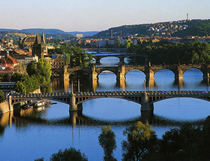
| The Vltava River flows through the centre of Prague and is the waterway around which the city has developed over several thousand years. On one side lie the Old Town (Staré Město), Jewish Quarter (Josefov) and New Town (Nové Město). On the other sits the Lesser Town (Malá Strana), above which rises Prague Castle (Pražský hrad). Connecting the two sides in the heart of Prague is Charles Bridge (Karlův most), a historic pedestrian crossing and a focal point for visitors. From the bridge, the 360° views over the Vltava River and the surrounding architecture are striking, with the vista towards Prague Castle particularly impressive. For the ultimate experience of the river, stroll across Charles Bridge, take a river cruise beneath it, then climb either the Old Town Bridge Tower or Lesser Town Bridge Tower for elevated perspectives of the city.
Another way to enjoy the river scene in Prague is to dine at one of the riverside restaurants, some of which offer terraces overlooking the water.
Stretches of the river embankment have been renovated for walking and cycling. In the Old Town, the most developed area of the embankment is around Čech Bridge. In the New Town, walk along the river towards Vyšehrad, passing the National Theatre and Dancing House, to reach Náplavka at Rašínovo Nábreží near Palacký Bridge (Palackého most) in Prague 2. Here, the embankment has been transformed into a lively area with riverside cafés and a cluster of floating boat bars. There is also a Farmer's Market on Saturday, plus occasional food and drink festivals.
Nature is ever present along the Vltava River. Swans and ducks drift in search of food, while other birds glide on thermals before swooping down to catch fish. At Cihelná Park, between Manes Bridge (Mánesův most) and Charles Bridge in the Lesser Town, a path meanders by the river and leads down to the waterside, where families with small children gather to feed the wildlife.
The section of the Vltava River running through Prague represents only a small fraction of its total length. The Vltava is the longest river in Czechia at 434 km. It flows from the Bohemian Forest in the south, winds its way through Prague, then joins the River Elbe in the north. Outside the capital it meanders through attractive countryside, occasionally passing castles and other historical buildings. The river has played a fundamental role in the foundation and history
of Prague. For early inhabitants of the region it provided fresh water for drinking and crop irrigation, and served as a means of navigation for settlements along its banks and for travellers moving along trade routes between Southern and Northern Europe. The flow of the Vltava is strong in Prague, particularly at certain times of the year, so the water also powered mills and local industry. To manage the river and aid navigation, eight dams, a large canal and weirs have been constructed along the Slapy–Prague–Mělník stretch. |